Cloudways Autonomous is the auto-scaling WordPress hosting platform Cloudways launched in 2024, built on Google Kubernetes Engine (GKE) and priced directly against WP Engine and Kinsta.
We bought a plan on release, deployed our standard WordPress test site on it, and monitored it continuously from March 4, 2024 to November 11, 2025 for 618 days with 889,920 response-time and uptime checks at a fixed 60-second interval.
We ended monitoring on November 11, 2025. Everything on this page is the complete dataset from that window, not a sample. If Cloudways makes a material change to the Autonomous platform, we will bring the test site back online and resume monitoring.
Note: This review is based on our testing of the Cloudways Autonomous base plan. The performance figures are measured data; the recommendations reflect our editorial assessment of those results. Unless stated otherwise, everything here applies to the base plan while other Cloudways Autonomous plans may produce different benchmark results.
Cloudways is running a summer promotion until 15 September 2026: 40% off for four months with the code SUMMER404, plus unlimited free expert-led migrations. It applies to every plan, including Autonomous. On the $11 DigitalOcean Standard plan that’s $6.60/month and $17.60 saved across four months, against $9.90 over three months with our year-round HOSTINGSTEP code.
Check Cloudways dealCloudways Autonomous at a glance
| Monitoring window | March 4, 2024 – November 11, 2025 (618 days) |
| Checks performed | 889,920 (60-second interval) |
| Average TTFB | 366ms across the full window |
| Uptime | 99.998% — 2 outages, 14 minutes total downtime |
| Load test | 20ms average, 0% errors at 500 concurrent users |
| Infrastructure | Google Kubernetes Engine |
| Price | $35/month ($24.50/month for the first 3 months) |
How we tested Cloudways Autonomous
We buy every hosting account ourselves and never accept complimentary or promotional plans. The Autonomous test site ran an identical WordPress install to every other host in our test bench with same theme, same plugin set, same PHP version, so the numbers below are comparable across providers rather than being a one-off snapshot.
- TTFB and uptime: Pingdom synthetic monitoring, one check every 60 seconds, 24 hours a day, for the full 618 days.
- Load handling: Loader.io, ramping to 500 concurrent users over 60 seconds, measuring average response time and error rate.
- Test environment: WordPress on the Twenty Twenty-Four theme, running WP Fastest Cache, Rank Math and Contact Form 7 on PHP 8.1.
You can read the full test bench setup on our testing methodology page, and see how every provider we track compares in our WordPress hosting benchmarks.
Cloudways Autonomous performance data
Response time (TTFB)
Across the full 618-day window, Cloudways Autonomous averaged 366ms. Splitting the data by year shows a modest slowdown in the second year rather than a sudden regression.
| Period | Days | Checks | Average TTFB | Fastest | Slowest |
|---|---|---|---|---|---|
| Mar 4 – Dec 31, 2024 | 303 | 436,320 | 355ms | 221ms | 489ms |
| Jan 1 – Nov 11, 2025 | 315 | 453,600 | 377ms | 281ms | 828ms |
| Full window | 618 | 889,920 | 366ms | 221ms | 828ms |
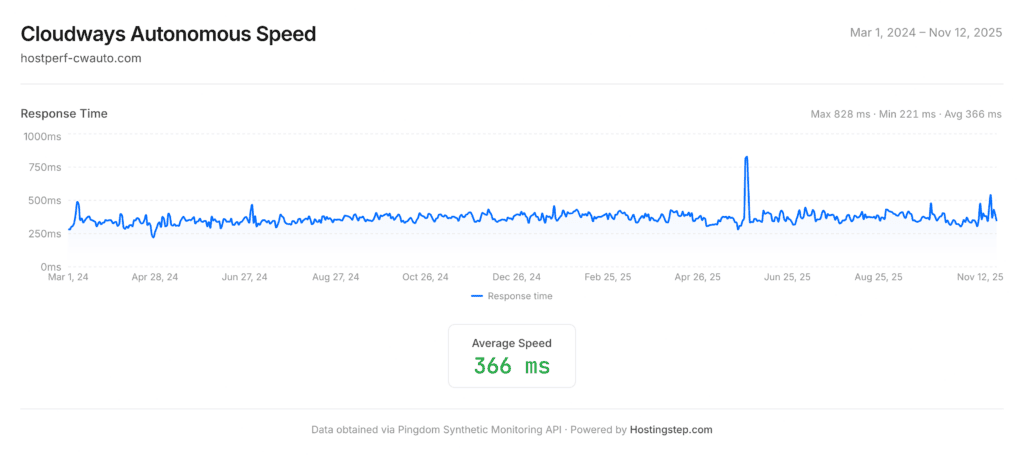
The 2025 figure is 22ms slower than 2024, and the slowest recorded month moved from 489ms to 828ms. That widening spread is worth noting: the average stayed strong, but the platform became less consistent over time rather than more.
Uptime
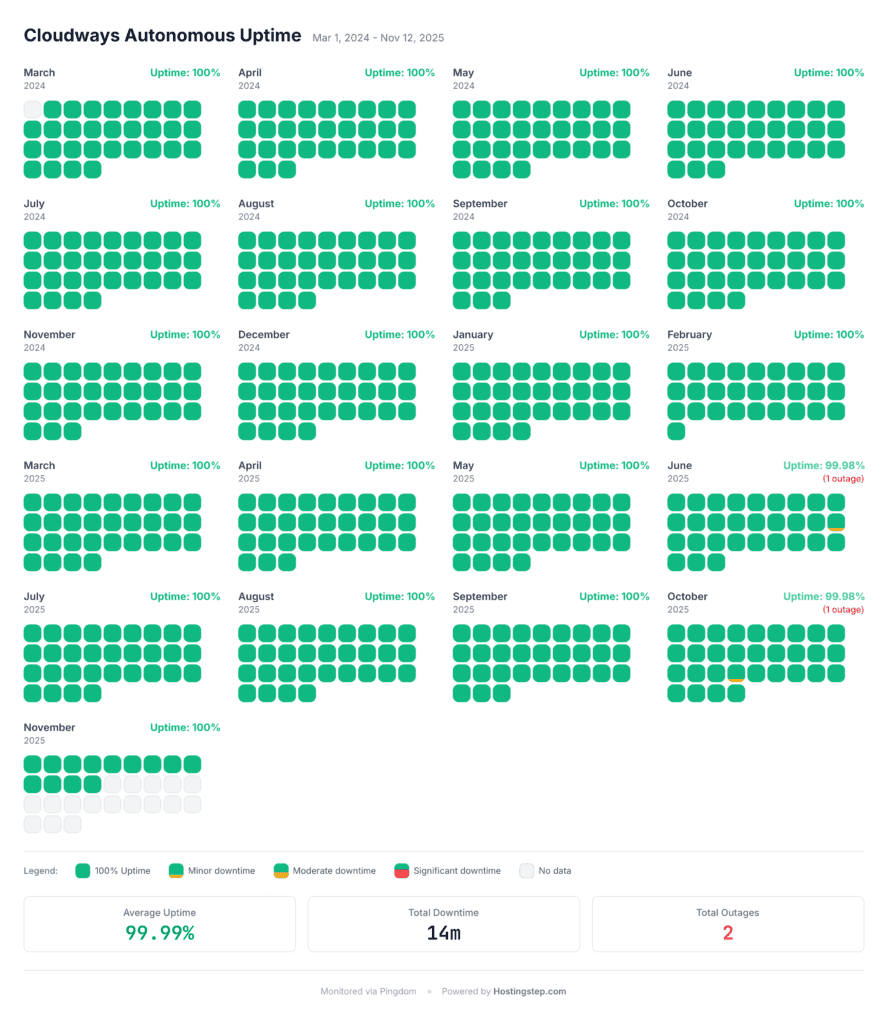
Autonomous recorded 99.998% uptime across the full window, with two outages totaling 14 minutes. Both fell in 2025 and the 2024 portion of the test ran 436,320 consecutive checks without a single failed request.
| Period | Uptime | Outages | Downtime | Worst single day |
|---|---|---|---|---|
| Mar 4 – Dec 31, 2024 | 100.000% | 0 | 0 minutes | 100.00% |
| Jan 1 – Nov 11, 2025 | 99.997% | 2 | 14 minutes | 99.44% |
| Full window | 99.998% | 2 | 14 minutes | 99.44% |
Fourteen minutes of downtime over 618 days is an excellent result, and it holds up against anything else in the managed WordPress category.
Load handling
Under a Loader.io test ramping to 500 concurrent users over 60 seconds, Cloudways Autonomous returned a 20ms average response time with a 0% error rate. It served every request in the run without a single timeout or error.
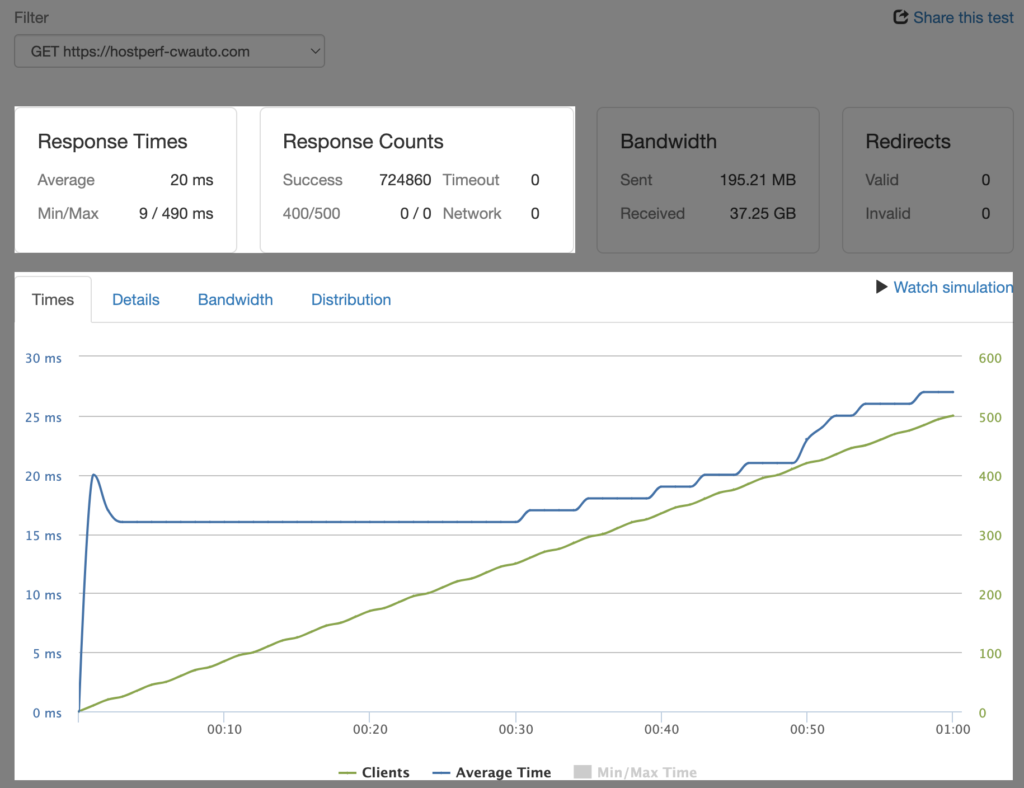
This is the strongest part of the platform, and it is the direct result of two things working together: Cloudflare Enterprise serving full-page cache at the edge, and GKE adding capacity behind it as request volume climbs.
Cloudways Autonomous vs WP Engine and Kinsta
WP Engine and Kinsta are the two hosts Autonomous was built to compete with, and both sit at the same price point. All three ran on our test bench simultaneously, so the response time and uptime figures below cover the same calendar periods on identical WordPress installs.
| Host | 2024 TTFB | 2025 TTFB | 2025 uptime | 2025 outages | Load test |
|---|---|---|---|---|---|
| Cloudways Autonomous | 355ms | 377ms | 99.997% | 2 (14 min) | 20ms |
| WP Engine | 463ms | 365ms | 99.995% | 1 (25 min) | 27ms |
| Kinsta | 466ms | 459ms | 99.971% | 5 (149 min) | 40ms |
Cloudways Autonomous was the fastest of the three in 2024 by a wide margin of roughly 110ms ahead of both rivals. By 2025 that gap had closed almost entirely against WP Engine, which improved from 463ms to 365ms following its infrastructure upgrade while Autonomous drifted the other way. Kinsta was the slowest throughout and had the weakest reliability record, with five outages and nearly two and a half hours of downtime in 2025.
On load handling, Autonomous held the lead over both: 20ms against 27ms for WP Engine and 40ms for Kinsta. Note that our WP Engine and Kinsta test sites are still being monitored, so their figures continue to move; the Autonomous numbers are final as of November 11, 2025.
If you are weighing Autonomous against a standard Cloudways server rather than an external competitor, we have a dedicated breakdown in our Cloudways Flexible vs Autonomous comparison.
Cloudways Autonomous features
Auto-scaling on Google Kubernetes Engine
Autonomous runs on GKE and scales horizontally when traffic climbs, adding PHP workers to absorb demand and releasing them once volume drops back. There is no resource slider to manage and no server size to pick — the platform handles it. This is the single biggest departure from a standard Cloudways server, where you choose a server size upfront and resize it manually when you outgrow it.
In practice this is what the 20ms load test result reflects. If your current Cloudways server regularly pins at 100% CPU usage, that is the clearest signal that Autonomous is worth the upgrade.
Cloudflare Enterprise CDN
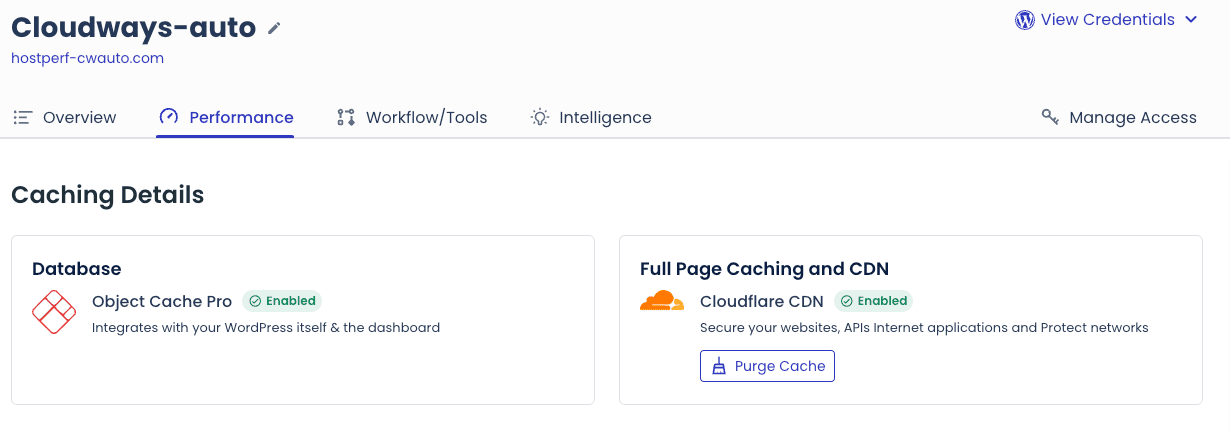
Cloudflare Enterprise ships pre-installed with full-page caching switched on by default, and also handles DDoS mitigation. Buying Enterprise directly from Cloudflare costs upwards of $200 per month, so bundling it at this price point is a substantial part of the value here.
Object Cache Pro
Object Cache Pro is a $79/month premium plugin that Cloudways includes at no extra cost. It caches database queries, which matters for anything a CDN cannot help with logged-in users, cart pages, admin screens and dynamic queries. A CDN handles the front end; Object Cache Pro handles what happens behind it.
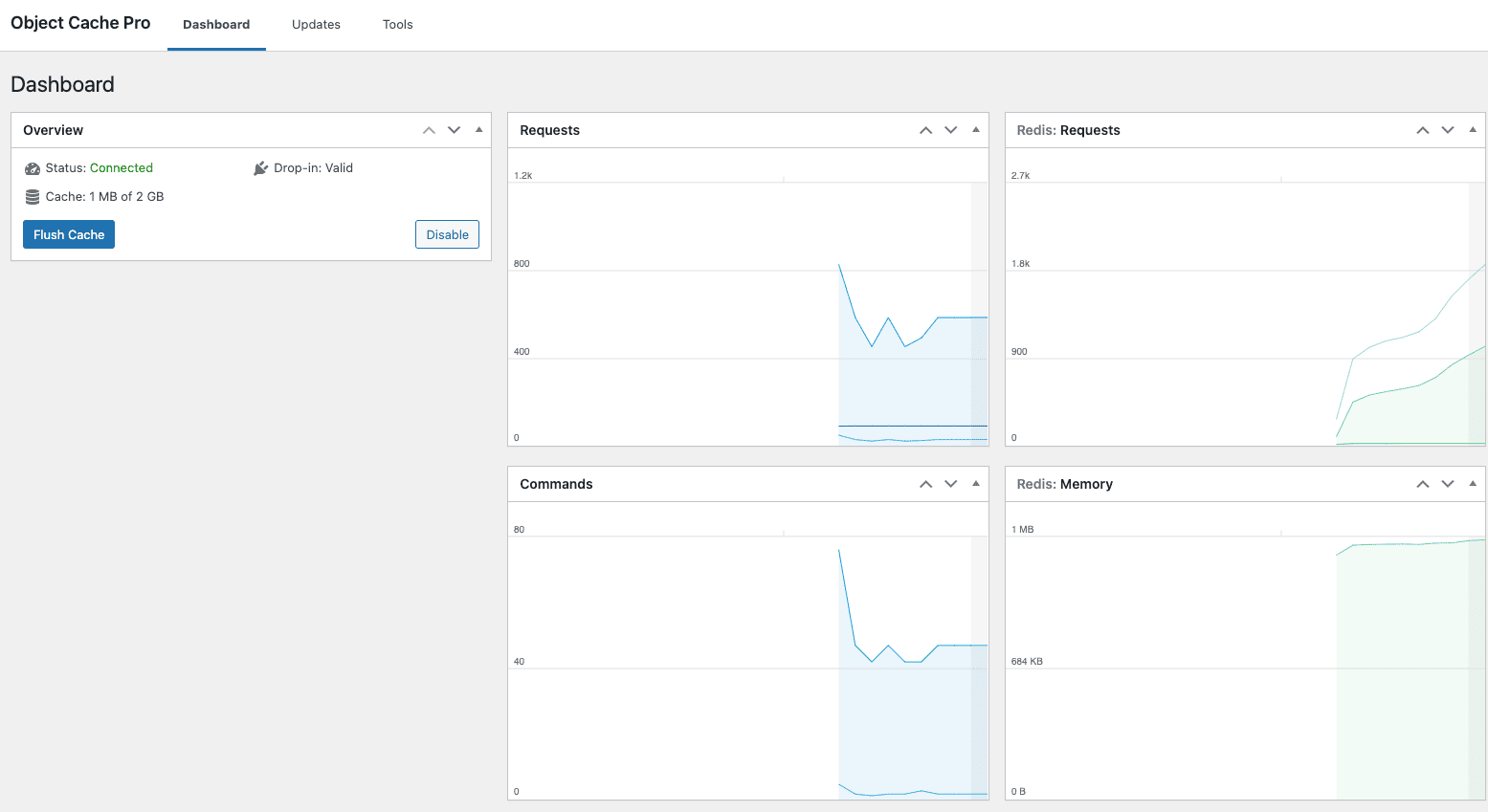
Cloudways has shipped Object Cache Pro on its earlier plans for years, so the integration is mature rather than newly bolted on. Cache statistics are readable directly from the WordPress dashboard.
Staging environments
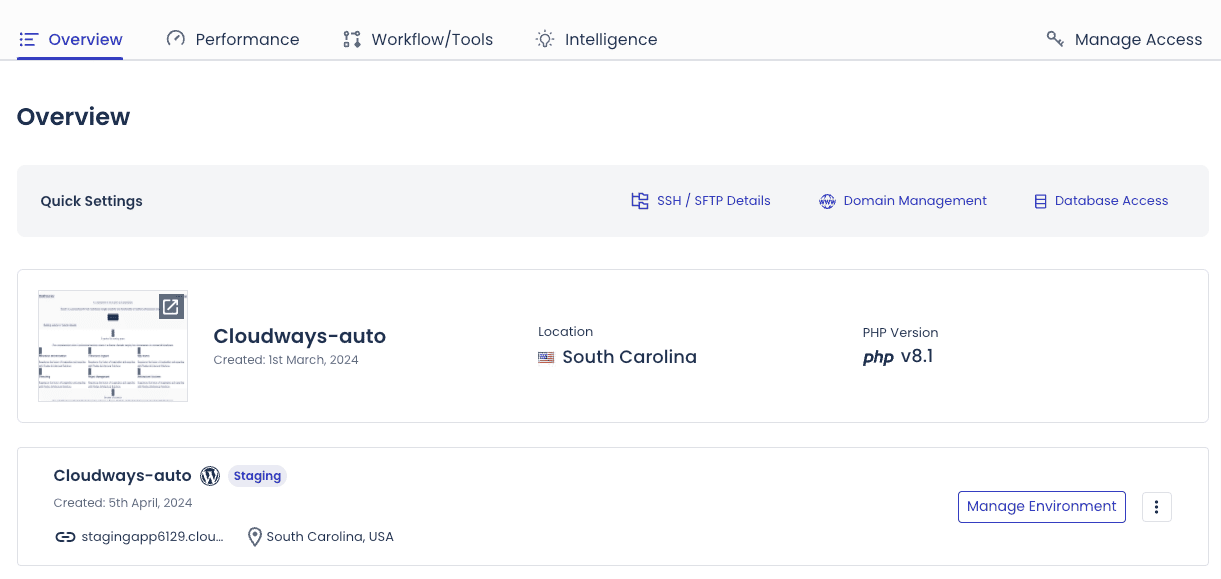
Staging is a single click, with push and pull in both directions. We created a staging copy of the test site, made changes, and pushed them to production without touching the command line. Selecting Manage Environment opens the staging settings where both options sit.
Backups and restore
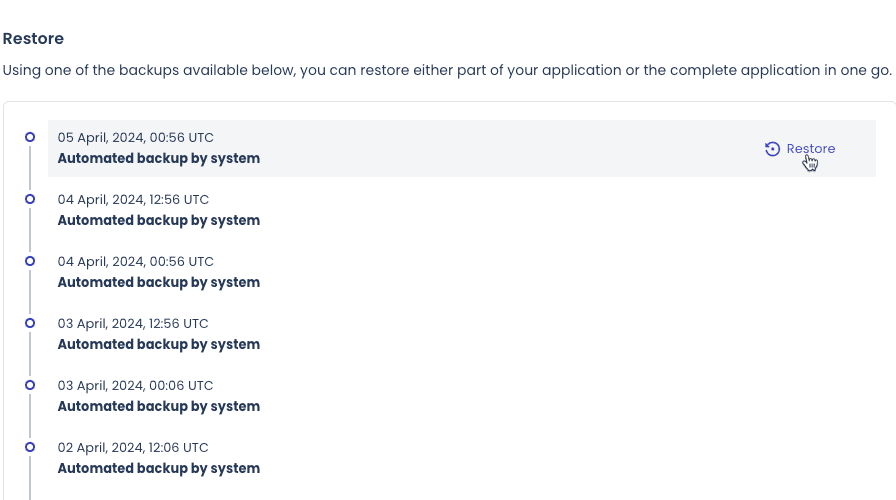
Autonomous keeps 14 days of automated backups and allows manual backups on demand. Restores are date-based, hover over any date in the log and the restore runs after a couple of confirmations. Fourteen days is shorter than some competitors offer, so if you need longer retention, plan for an off-site backup plugin alongside it.
Cloudways Autonomous pricing
The entry plan is $35 per month, discounted to $24.50 per month for the first three months, after which the standard $35 rate applies. That covers one WordPress application, 15 GB of storage, 30,000 monthly visitors and 100 GB of bandwidth.
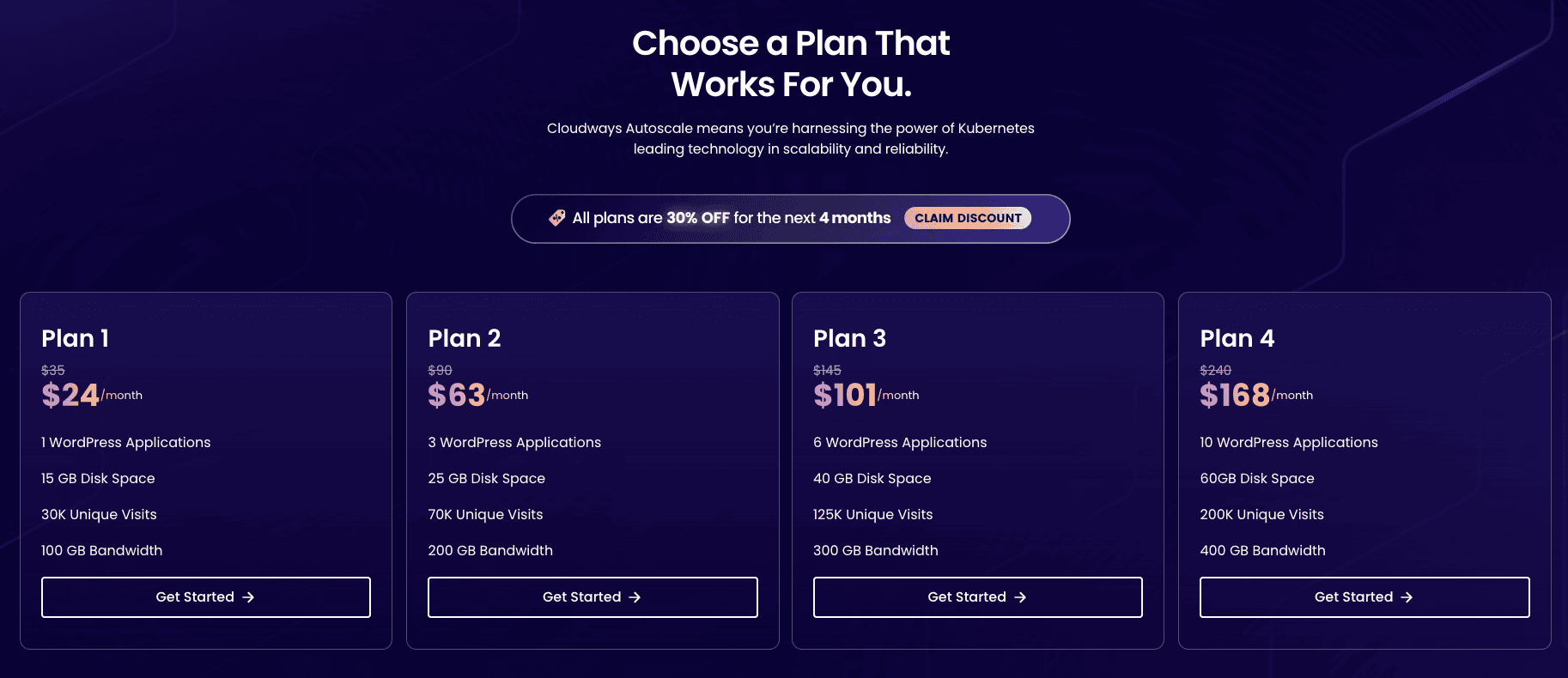
| Host | Entry price | Monthly visits | Storage | Auto-scaling | CDN |
|---|---|---|---|---|---|
| Cloudways Autonomous | $35/month | 30,000 | 15 GB | Yes | Cloudflare Enterprise |
| WP Engine | $30/month | 25,000 | 10 GB | Yes | Standard CDN |
| Kinsta | $35/month | 25,000 | 10 GB | Yes | Kinsta CDN |
Autonomous gives you more visits and more storage than either rival at the same price, and Cloudflare Enterprise plus Object Cache Pro are bundled rather than sold as add-ons. Current discounts are listed on our Cloudways promo code page.
How to set up Cloudways Autonomous
Log into the Cloudways control panel and click Add Application. Enter an application name, pick your data center region, choose WordPress or WooCommerce, and confirm.
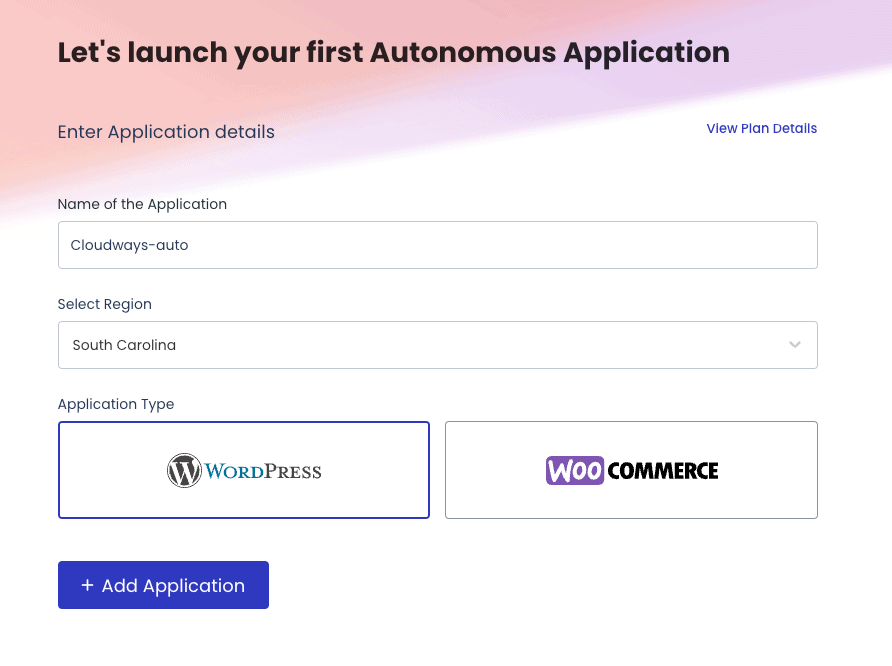
The site is created with login credentials generated automatically. Click Manage Access, enter your domain, and Cloudways issues a CNAME record, add it to your DNS and the site goes live. The dashboard is split into four tabs:
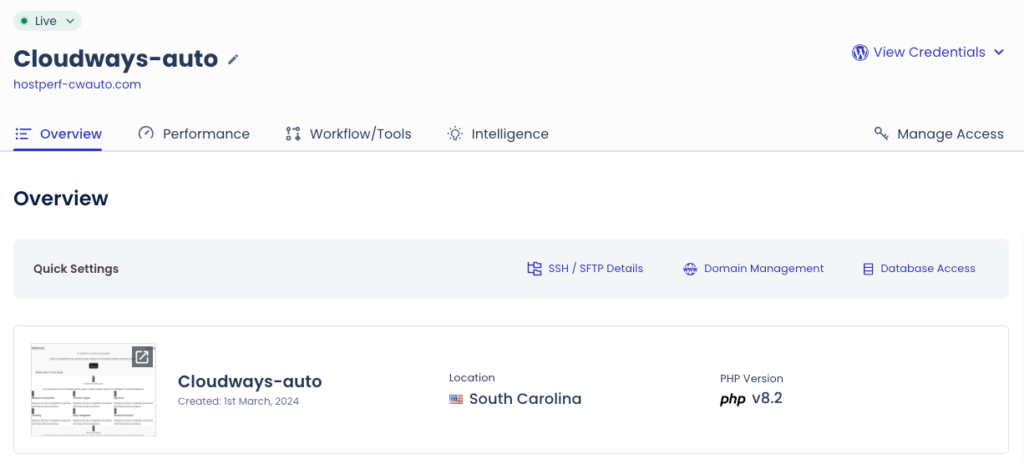
- Overview: site details, PHP version, staging setup, and usage logs for visits, disk space and bandwidth, plus quick access to SSH/SFTP, domains and the database.
- Performance: Object Cache Pro and Cloudflare CDN controls.
- Workflow/Tools: backups, restores, PHP settings and staging.
- Intelligence: logs and traffic analytics.
What we liked and what we didn’t
What we liked
- Best load handling of the three hosts we compared. 20ms with zero errors at 500 concurrent users, ahead of WP Engine and Kinsta.
- Near-perfect reliability. Two outages and 14 minutes of downtime across 618 days, including a full 303-day stretch with none at all.
- Genuinely hands-off scaling. No server sizing, no manual resizing, no CPU alerts to chase.
- Premium add-ons bundled. Cloudflare Enterprise and Object Cache Pro would cost close to $280 a month bought separately.
What we didn’t
- Response times drifted in year two. 355ms in 2024 became 377ms in 2025, and the slowest reading widened from 489ms to 828ms while WP Engine moved in the opposite direction.
- Limited data center choice. Fewer regions than Kinsta, and your site lives in one region only visitors far from it depend on the CDN to close the gap.
- Backup retention is only 14 days. Shorter than several competitors at this price.
- Premium entry price. At $35/month it is hard to justify for a low-traffic blog or a small brochure site.
Verdict
Over 889,920 checks spanning 618 days, Cloudways Autonomous delivered 366ms average response times, 99.998% uptime and the best load handling of any host we ran alongside it. For a platform in its first two years, that is a strong record, and the auto-scaling architecture does what it claims, it absorbed 500 concurrent users without dropping a request.
The reservation is direction of travel. Autonomous led WP Engine by more than 100ms in 2024 and had effectively lost that lead by late 2025, not because it collapsed but because it slowed slightly while WP Engine improved. Anyone choosing between the two on raw speed alone now has a much closer decision than the 2024 data suggested.
It makes most sense for sites with unpredictable traffic, WooCommerce stores running seasonal sales, news and media sites, and agencies who would rather not field CPU alerts. If your traffic is steady and modest, you are paying for scaling headroom you will never use, and a standard Cloudways server or a cheaper managed plan will serve you better. Our fastest WordPress hosting rankings cover the alternatives.
Frequently asked questions
Is Cloudways Autonomous still being tested by HostingStep?
No. We ended monitoring on November 11, 2025 after 618 days and 889,920 checks. The data on this page is the complete final dataset. If Cloudways significantly changes the platform, we will redeploy the test site and resume monitoring.
Should you upgrade to Cloudways Autonomous?
If your existing Cloudways server frequently hits 100% CPU usage, yes, that is exactly the problem auto-scaling solves. If you are not hitting resource limits, stay on your current setup and save the difference.
How do you migrate to Cloudways Autonomous?
Cloudways includes one free managed migration. You can also use their Cloudways Migrate WordPress plugin to move any number of sites yourself.
Will the price go up after the promotional period?
The 30% discount applies to the first three months only. After that you pay the standard $35 per month. Cloudways has a long record of not raising prices on existing plans, so the $35 rate should hold.
What is the difference between Cloudways Flexible and Autonomous?
Flexible plans run on a server you size and resize yourself. Autonomous scales automatically on GKE and includes Cloudflare Enterprise and Object Cache Pro by default, both of which require separate setup on Flexible. Flexible is cheaper and more configurable; Autonomous is faster under load and requires no server management.
How does auto-scaling actually work?
GKE monitors CPU, memory and request load in real time and scales horizontally by adding PHP workers as demand rises, then releases them once traffic normalises. No manual intervention is required at any point.
Performance data collected between March 4, 2024 and November 11, 2025. Hosting account purchased independently by HostingStep. See all our hosting reviews.