20 August 2026: We’ve analyzed 304 days of continuous monitoring from October 1, 2025 to July 31, 2026, covering TTFB, Uptime, and load tests, and here is what we found. Cloudways Premium and Cloudways Standard are now separated by 1ms of TTFB and score identically on server hardware.
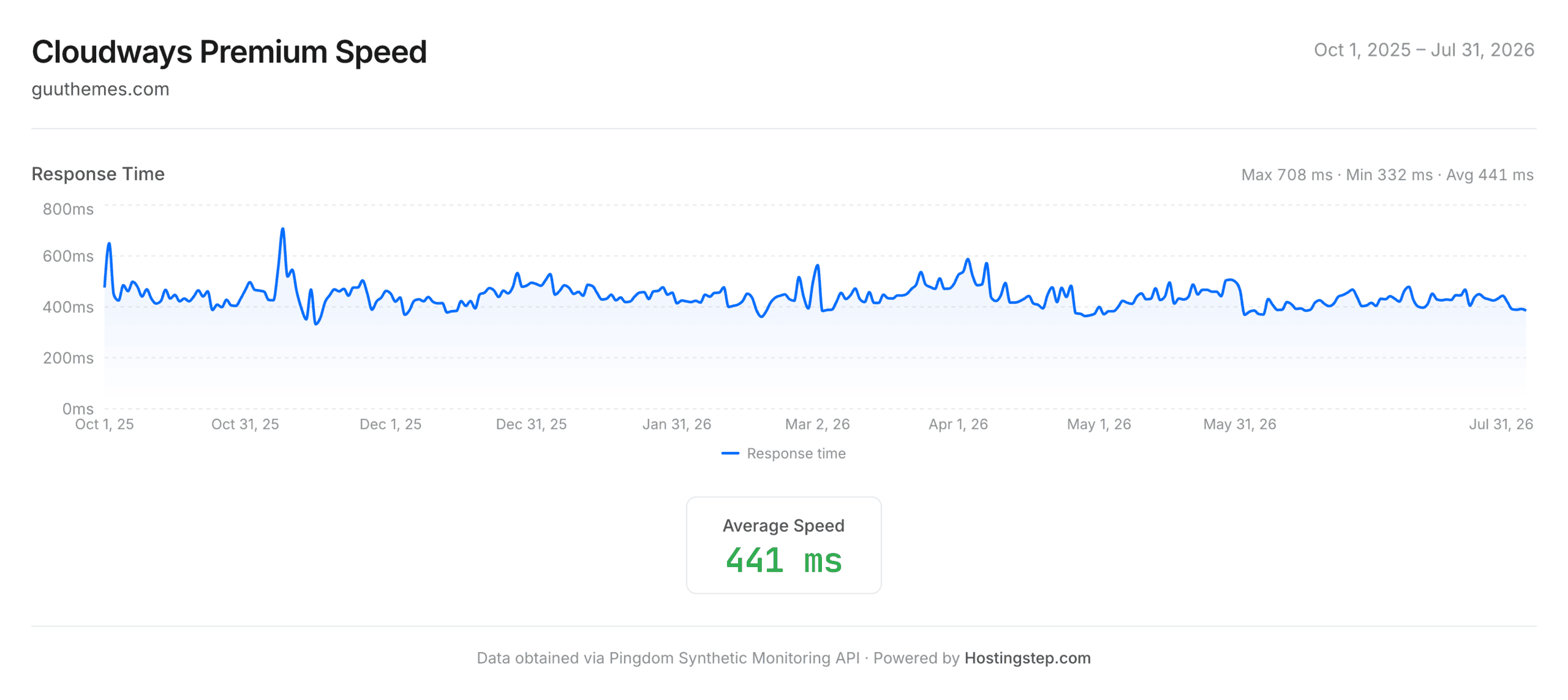
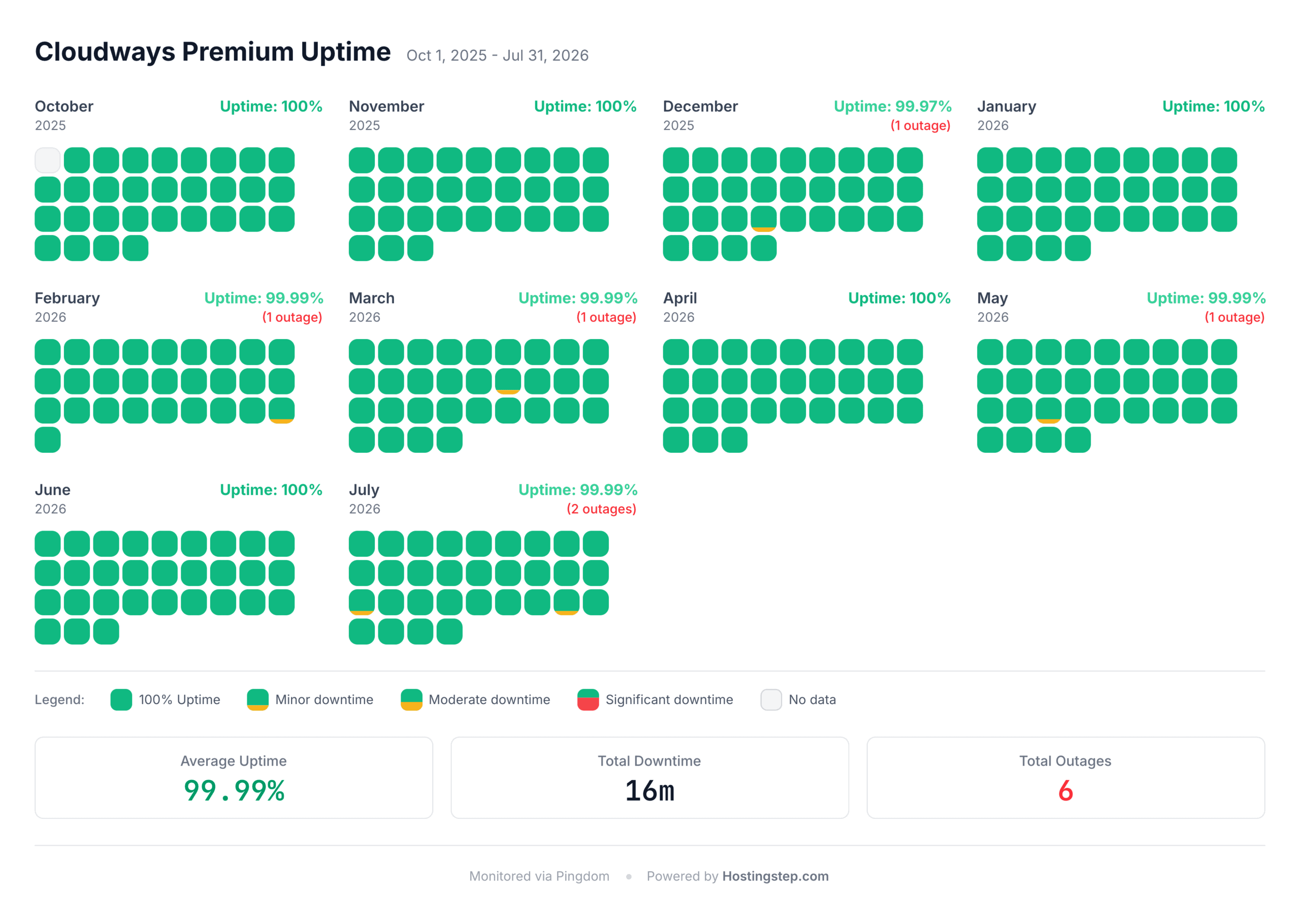
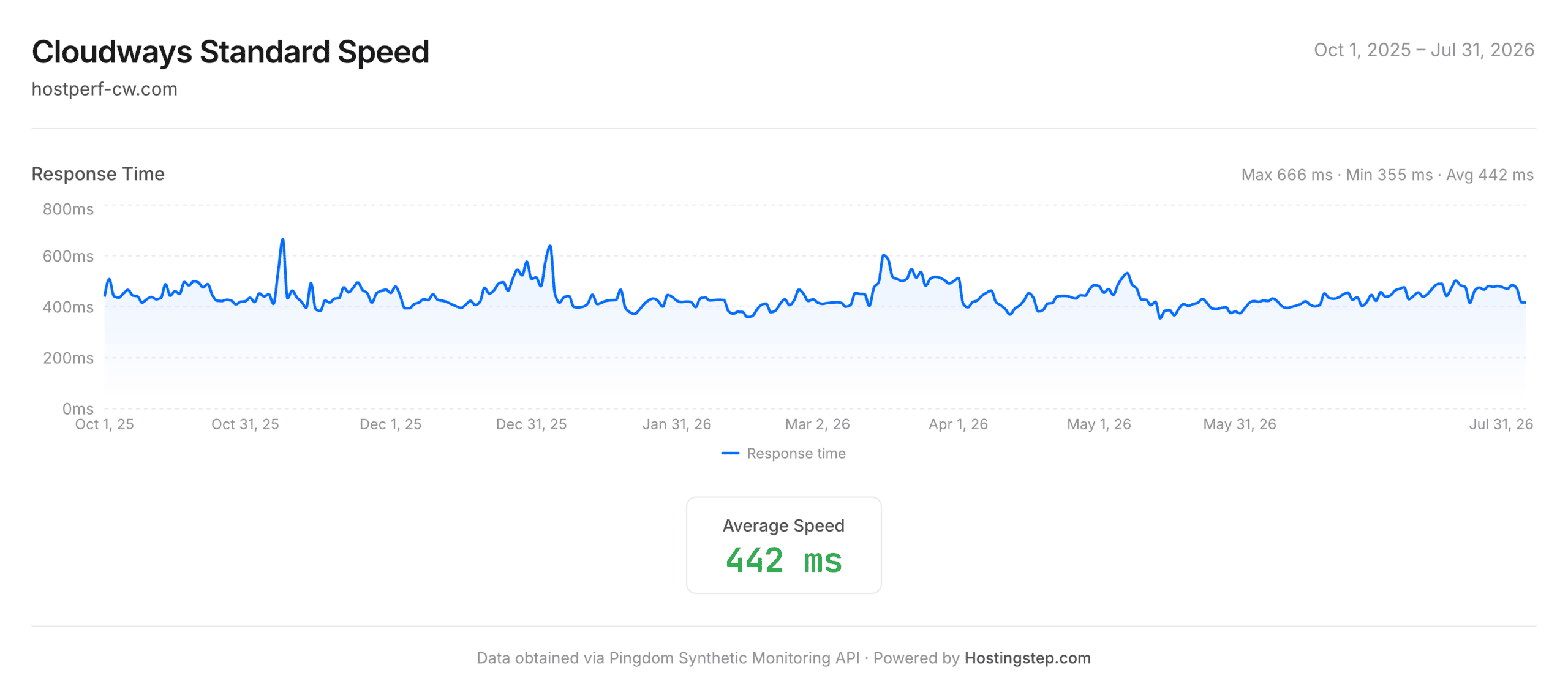
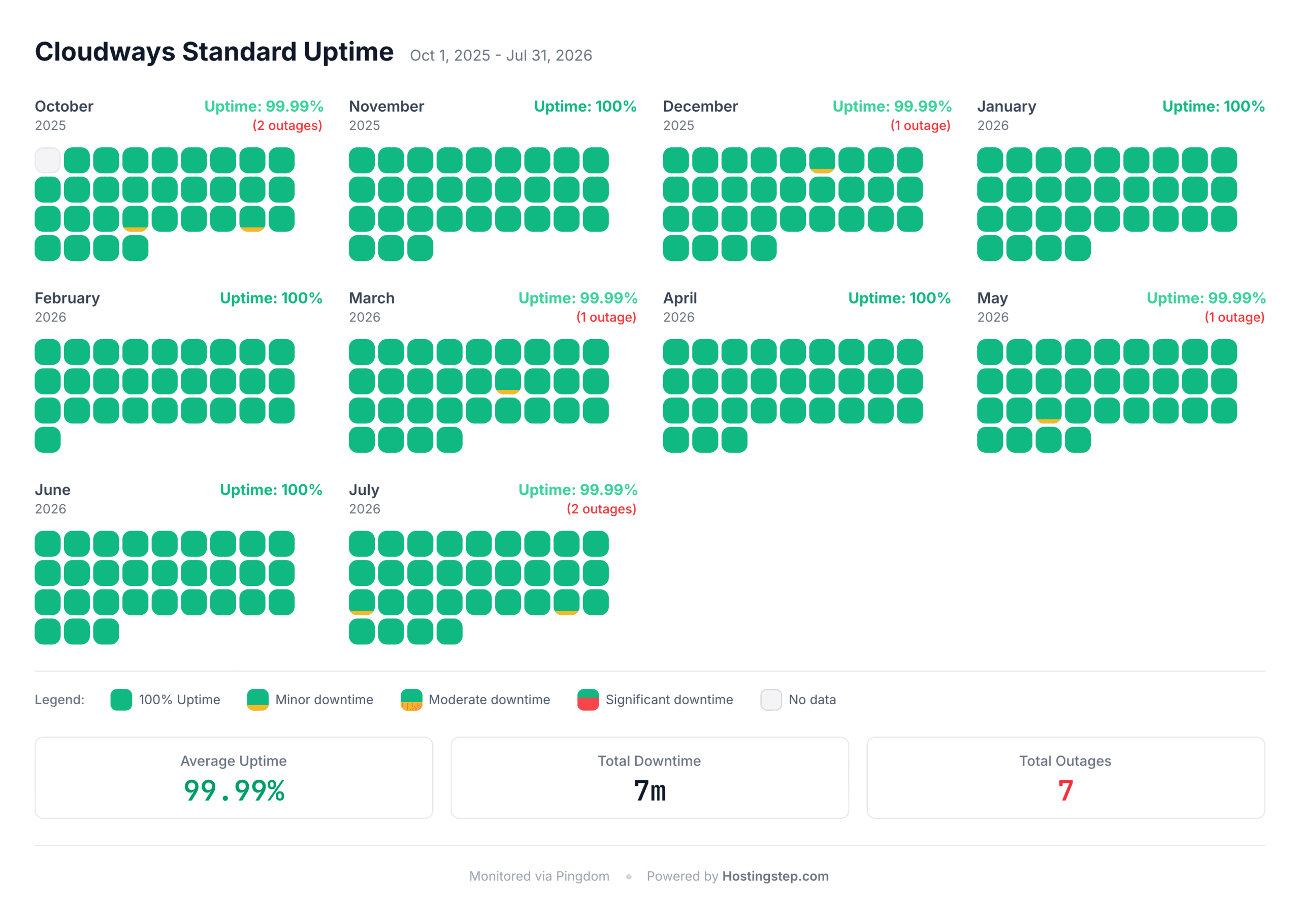
Cloudways Premium recorded an average response time of 441ms, 99.9962% uptime with 16 minutes of downtime, and a 360ms load-handling response time at a 0% error rate. Whereas, Cloudways Standard recorded an average response time of 442ms with 99.9983% uptime, 7 minutes of downtime, and a 443ms load-handling response time, also at 0% errors. On our latest WPBenchmark test, Premium and Standard both scored 4.7 out of 10.
While our initial comparison found that Premium performs better than Standard, the long-term data show that their performance is very similar. This is why Hostingstep.com invests in long-term data collection for more accurate and comprehensive analysis of hosting performance.
What do we suggest? Cloudways DigitalOcean Standard at $11 is the right default for most sites. If you need genuine hardware headroom, neither DigitalOcean plan delivers it, so choose Cloudways Vultr HF. They also offer you Cloudways Promo code. Over the same 304-day window, Cloudways Vultr HF averaged 428ms TTFB with 99.9986% uptime, a 288ms load-handling response time at a 1.7% error rate, and a WPBench score of 7.6 against 4.7 on both DigitalOcean plans.
Cloudways Standard wins on value. Premium leads on load handling only.
Across 304 days of continuous monitoring, Cloudways DigitalOcean Premium and Cloudways DigitalOcean Standard returned near-identical results: 441ms against 442ms average TTFB, and an identical WPBench server hardware score of 4.7. Standard recorded less downtime, 7 minutes against 16. Premium’s only measurable advantage is load handling at 360ms against 443ms, with both plans completing every request at a 0% error rate.
Elite 9.0+Strong 7.5–8.9Average 6.0–7.4Below 4.5–5.9Poor <4.5
| Metric | Cloudways DO Premium | Cloudways DO Standard | Cloudways Vultr HF |
|---|---|---|---|
| Average TTFB | 441ms | 442ms | 428ms |
| Uptime | 99.9962% | 99.9983% | 99.9986% |
| Downtime · outages | 16 min · 6 | 7 min · 7 | 6 min · 4 |
| Load handling | 360ms · 0% | 443ms · 0% | 288ms · 1.7% |
| Server hardware (WPBench) | 4.70 | 4.70 | 7.60 |
| Price | $14/month | $11/month | $16/month |
Measured on hosting accounts we purchased ourselves. TTFB and uptime from Pingdom at 60-second intervals, October 1, 2025 – July 31, 2026 (304 days, 437,760 tests per plan). Load handling from Loader.io, 0 to 100 concurrent users over 60 seconds. Server hardware from WPBenchmark. Powered by Hostingstep.com
Our verdict: buy Cloudways DigitalOcean Standard at $11 per month. The $3 per month Premium upgrade buys 83ms of load-handling headroom and nothing else we can measure. If you need genuine server hardware, neither DigitalOcean plan supplies it — Cloudways Vultr HF scores 7.6 on WPBench against 4.7 for both.
If you’re considering signing up for Cloudways and are uncertain about choosing between DigitalOcean Premium and Standard plans, you’ve landed on the right page.
As part of the Hostingstep methodology, I purchased a hosting account on both Premium and Standard plans, installed identical test sites, and placed them under 24/7, 365-day performance monitoring using the industry’s best tools.
Cloudways is running a summer promotion until 15 September 2026: 40% off for four months with the code SUMMER404, plus unlimited free expert-led migrations. It applies to every plan, including Autonomous. On the $11 DigitalOcean Standard plan that’s $6.60/month and $17.60 saved across four months, against $9.90 over three months with our year-round HOSTINGSTEP code.
Check Cloudways dealCloudways Premium Vs Standard: Speed and Uptime Performance
TTFB and Uptime are the most crucial metrics for evaluating a hosting company’s speed and reliability.
Over the last 304 days, both the Cloudways Premium and Cloudways Standard plans have recorded near-identical TTFB of 441ms and 442ms, respectively. The uptime scores are also close at 99.9962% and 99.9983%, but here the Standard plan is the better of the two, recording 7 minutes of downtime across 7 outages against 16 minutes across 6 outages on Premium.
Load Test:
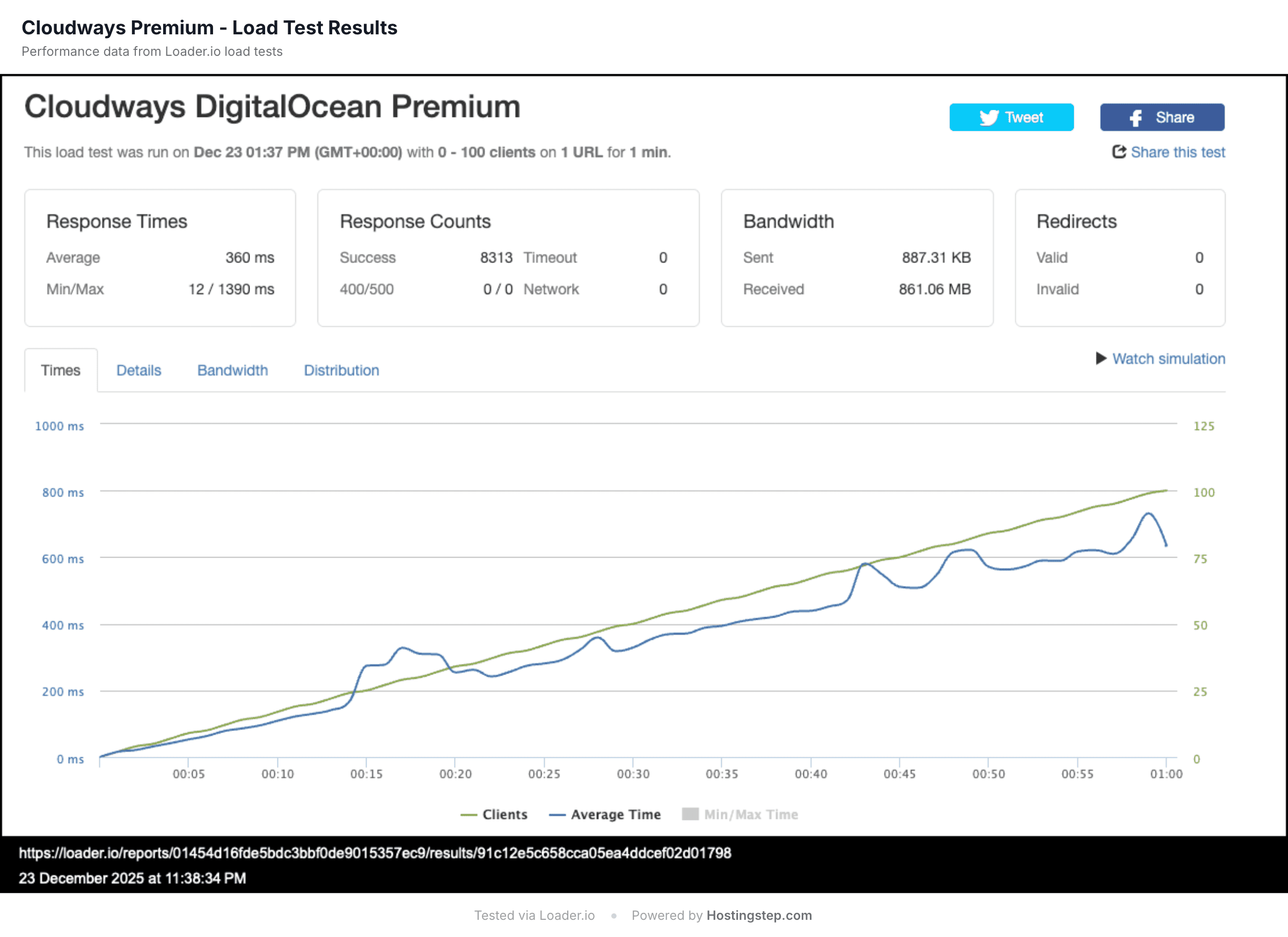
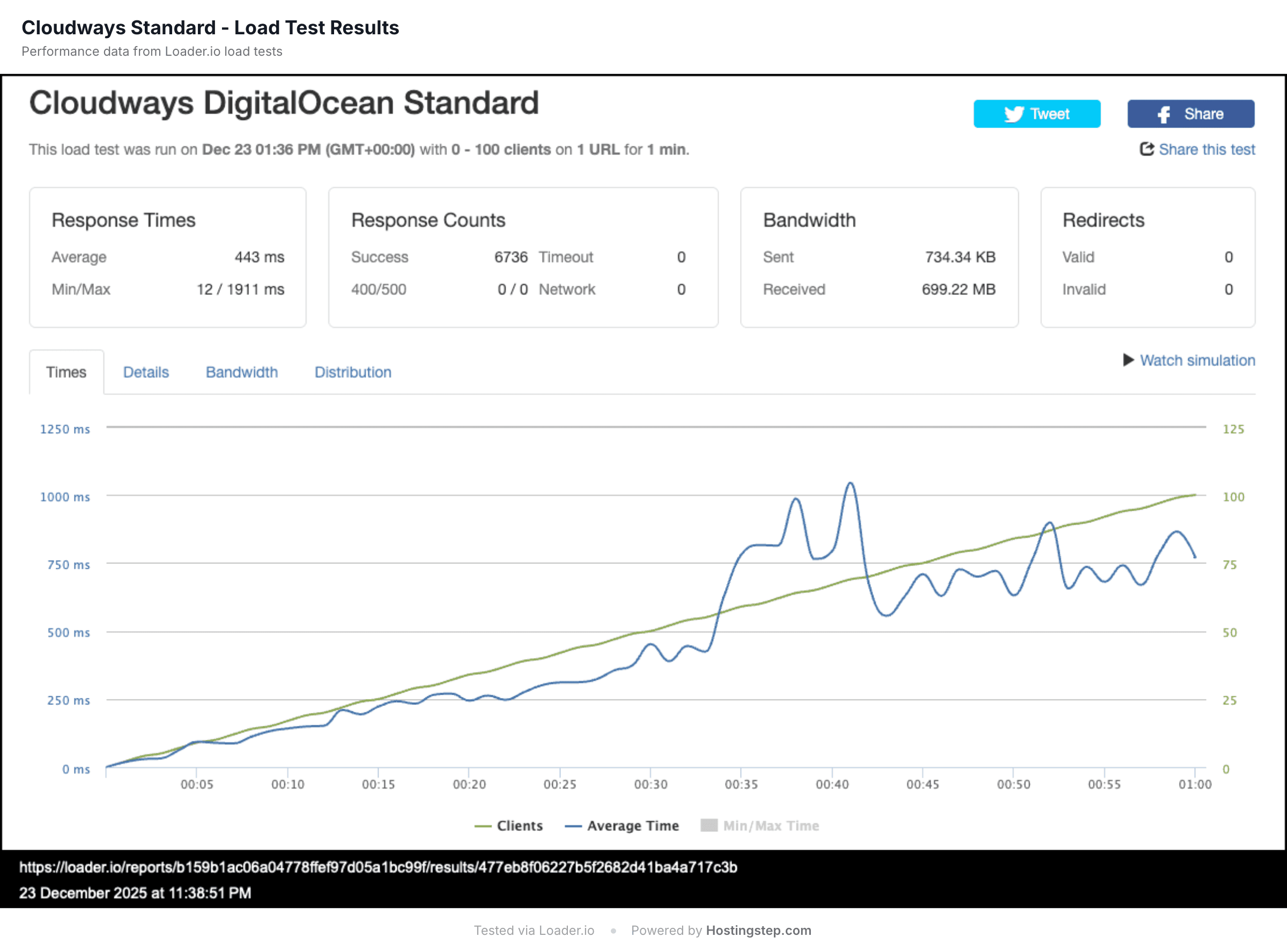
The load test measures how fast the servers work at handling traffic spikes. We ramp from 0 to 100 concurrent users over 60 seconds against both the Premium and Standard test sites, measuring average response time and any dropped requests.
In the load test, Cloudways Premium recorded an average response time of 360 ms, and Cloudways Standard recorded 443 ms. Both plans completed every request at a 0% error rate, so neither drops visitor traffic at peak load. The fact that “the lower the response time, the faster your server” means the Premium plan handles the load better, and this is the only metric on which it does.
Hardware performance:
On specification, Cloudways DigitalOcean Premium uses Intel Xeon Scalable processors with built-in AI acceleration and Intel mesh architecture.
Compared to the Standard series, Cloudways DigitalOcean Premium droplets run 2nd or 3rd generation Intel Xeon Scalable processors with NVMe storage and network throughput up to 10 Gbps, while Standard droplets run 2nd generation or earlier Intel CPUs with standard SSD at up to 2 Gbps.
Furthermore, Cloudways Premium offers accelerated memory and NVMe storage, while the Standard series uses SSD storage. It is important to note that NVMe drives have faster read/write speeds than traditional SATA SSDs. On paper, this is a meaningful specification gap.
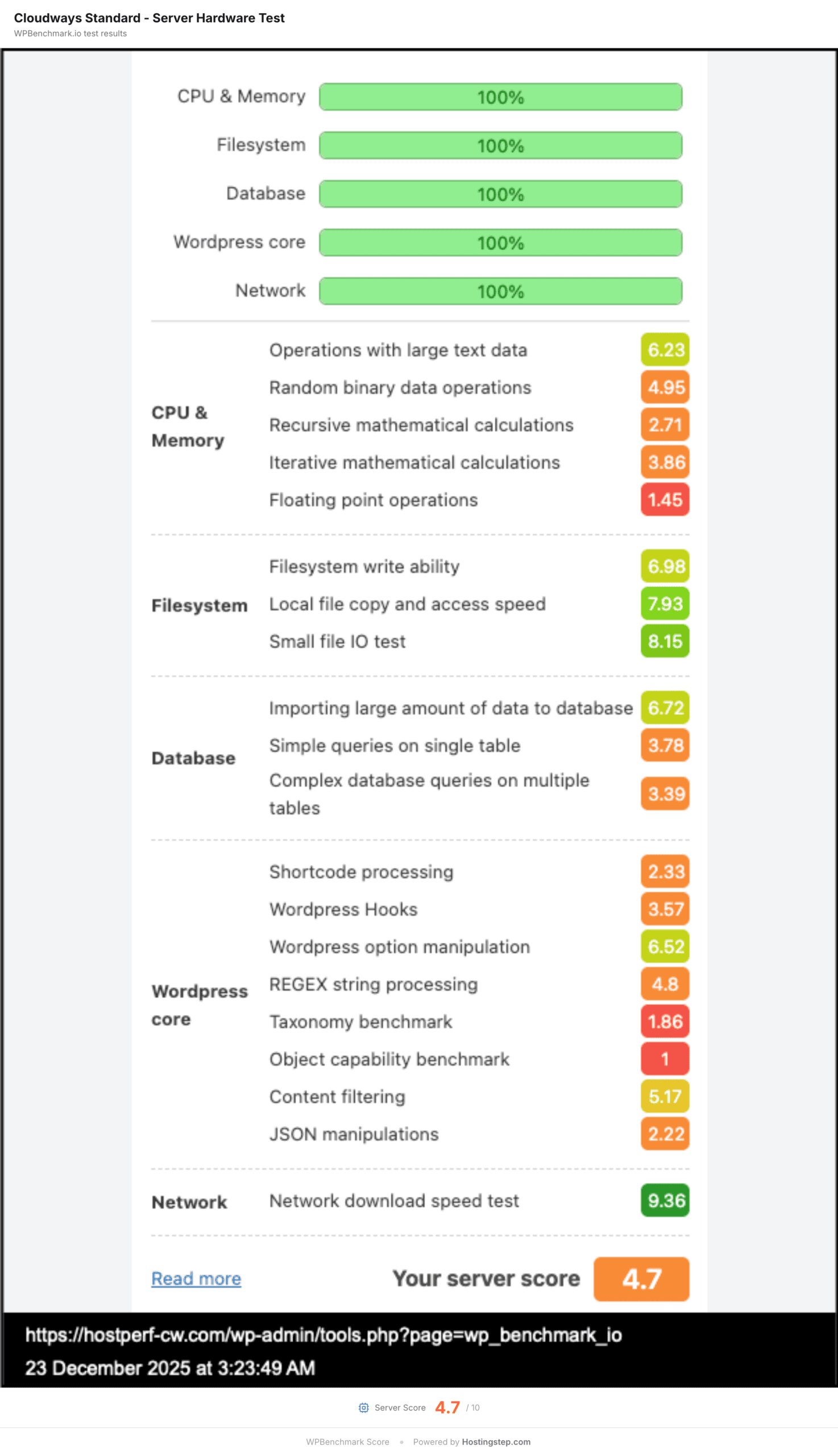
To validate whether Cloudways Premium delivers faster backend performance, we use the WPBenchmark Plugin to measure allocated server resources.
The results show that Cloudways Premium and Cloudways Standard both score 4.7 out of 10. Despite the NVMe and processor specification gap above, the two plans are allocated the same CPU, RAM and disk I/O, so the on-paper hardware advantage does not translate into measurable resource allocation. WPBench measures allocated resources only and is unaffected by web server software.
Based on our findings, the case for Cloudways Premium rests on load handling alone: it completes a 100-user ramp at 360ms against 443ms on Standard, both without dropping a request. That is worth having on a store or a site that sees sharp traffic spikes, but it does not come with the extra compute the specification sheet implies.
If your site is genuinely resource-intensive, neither DigitalOcean plan is the right answer at 4.7. Cloudways Vultr HF at $16 per month scores 7.6 on the same test, which is the plan to buy for plugin-heavy WordPress sites or WooCommerce stores.
Cloudways Premium Vs Standard: Pricing
The Cloudways Premium plan starts at $14/month and the Standard plan at $11/month, with no renewal markup on either — the price you sign up at is the price you keep. Save on Cloudways hosting with our coupon codes to get up to 30% off on all cloud providers. Note that Cloudways restructured its DigitalOcean lineup in 2026: the tiers are now named Micro, Small, Medium and up through 8XL rather than the old DO1GB to DO192GB labels.
Here is how the two entry plans compare, which are the plans we tested:
| Plan | Price | Renewal | RAM | vCPU | Storage | Bandwidth |
|---|---|---|---|---|---|---|
| Cloudways DigitalOcean Standard | $11/mo | $11/mo | 2 GB | 1 | 50 GB SSD | 2 TB |
| Cloudways DigitalOcean Premium | $14/mo | $14/mo | 2 GB | 1 | 50 GB NVMe | 2 TB |
Both plans scale vertically from there through the same tier ladder. Because Cloudways prices hourly and adjusts its lineup periodically, check the Cloudways pricing page for the current rate on larger servers rather than relying on a published table. Add-ons sit outside the plan price: Cloudflare Enterprise CDN from $4.99 per domain per month, and Rackspace email at $1 per mailbox per month.
Cloudways Standard vs Premium – Which is Best?
Cloudways Standard is our recommendation. Over 304 days the two plans are separated by 1ms of TTFB and score identically at 4.7 on server hardware, and Standard actually recorded less downtime. Premium’s better load handling, 360ms against 443ms, is the one advantage the data supports.
Start on Cloudways Standard. Move up to Premium only if you run a store or a site that sees sharp traffic spikes and you want the load-handling margin. If what you actually need is more compute, skip both and take Cloudways Vultr HF, which scores 7.6 on WPBench against 4.7 on either DigitalOcean plan.
Frequently Asked Questions
What is Cloudways Premium?
Cloudways Premium, or Cloudways DigitalOcean Premium Droplets, use 2nd or 3rd generation Intel Xeon Scalable processors with NVMe storage and higher network throughput than Cloudways Standard. In our testing the two plans returned the same WPBench score of 4.7, so the specification advantage does not show up as extra allocated compute.
Can I upgrade from a Standard Server to a Premium Droplet?
The vertical scaling feature allows you to upgrade from a Standard Server to a Premium Droplet. Here are the steps you need to follow to do it:
- Login to your Cloudways account and open Servers from the top menu bar
- Next up, choose the desired server that you want to scale up
- After that, select Vertical Scaling from under Server Management
- Next, get to the server size to select a server size and click on “Scale Now.”
What are the differences between Cloudways Premium and Cloudways Standard?
Cloudways Premium handles load better, completing a 100-user ramp at 360ms against 443ms on Cloudways Standard, with both at a 0% error rate. On TTFB, uptime and WPBench server hardware the two plans are level, and Standard costs $3 per month less.
What is the Cloudways Performance Difference between 2GB Standard and 2GB Premium?
The 2GB Standard and 2GB Premium plans return the same TTFB, uptime and WPBench hardware score. The 2GB Premium is faster under concurrent load.
Which Cloudways hosting plan should we buy, $11 or $14 premium?
The choice between the $11 plan and the $14 Premium plan on Cloudways depends on your website’s hosting requirements and performance needs. Based on our test, I recommend that the $11 plan is enough for most sites.
Ready to choose your Cloudways plan?
| Plan | Price | Pick it when |
|---|---|---|
| Cloudways DigitalOcean Standard | $11/mo | Default choice. Matches Premium on speed, uptime and hardware. |
| Cloudways DigitalOcean Premium | $14/mo | You want the load-handling margin on a store or spiky site. |
| Cloudways Vultr HF | $16/mo | You need real compute. WPBench 7.6 against 4.7. |
All three renew at the same price with no markup, billed hourly with no contract.
Changelog:
- August 20, 2026: Refreshed with 304 days of data (October 1, 2025 to July 31, 2026, 437,760 tests per plan). WPBenchmark retest returned 4.7 for both plans, so the hardware-advantage finding no longer holds and the recommendation now favours Standard. Removed obsolete plan pricing tables and rebuilt the page on the current Hostingstep design system.
- October 28: 2025: Added last 18 months performance data for long term reviews.
- March 25, 2024: Replaced old data and added data from January 1, 2024, to December 31, 2024. Optimized the content for better readability.
- April 10, 2024: Replaced old data with the latest January 1, 2023, to December 31, 2023 data.