
SiteGround Review 2026

SiteGround secured an overall score of 6.5 out of 10 and ranks #22 out of #34 providers we tested in our 2026 rankings, sitting in the “Below Average” tier. The host recorded a TTFB of 632 ms and an uptime of 99.97% in Q4 2025. We have been testing and monitoring SiteGround since 2020 with over 1,950 days of continuous monitoring and over 561,600 individual performance tests conducted. SiteGround recorded its best TTFB in 2022 with 403 ms while the TTFB has gone up to 632 ms in 2025, which clearly is a 57% degradation in the TTFB performance.
The host secured a WPBench score of 8.4, ranking among the top 5 out of 34 providers in terms of hardware resource allocation. However, the host recorded a global TTFB of 833 ms which reflects its weak delivery speed in global locations. In this article, we will get deeper into all the essential performance metrics and pricing to give you the clarity you need. Most importantly, we will explain who should choose SiteGround and who should avoid it.
Performance Overview
| Metric | Result | Score (/10) | Rating |
| TTFB (US) | 632ms | 4 | Poor |
| Uptime | 99.97% | 8.5 | Good |
| Load Test | 170ms / 0.00% error | 6 | Average |
| Global TTFB | 833ms | 4 | Poor |
| Server Hardware (WPBench) | 8.4 | 8.4 | Good |
| Performance Total | 3.59/10 | — | Below Average Tier |
SiteGround secured 3.59 out of 10 for its overall performance, which is a below average tier score. We see a contrast of excellent hardware and poor delivery speed. While SiteGround secured a WPBench score of 8.4 indicating strong hardware allocation on its plan, it secured only 4 out of 10 in both TTFB and global TTFB tests, signaling poor delivery speed for in the origin server country and globally.
SiteGround falls in the Below Average tier category, which means it sits in the bottom third position among 34 providers that we tested. However, SiteGround passed the load test with 170 ms and 0% errors, which means the host can handle traffic spikes without error even though the page loading is slow.
The gap between SiteGround’s strong hardware and weak speed delivery also suggest that the host’s software stack or CDN implementation is not helping the performance. SiteGround with its TTFB score of 4 out 10 sits in the 600 ms to 700 ms range along with ChemiCloud with 618 ms and DreamHost DreamPress with 599 ms.
TTFB Response Time
| Year | Avg TTFB | Uptime | Days Monitored | Tests | Outages |
| 2020 | 856ms | 99.99% | 110 | 31,680 | 7 |
| 2021 | 487ms | 99.99% | 365 | 105,120 | 14 |
| 2022 | 403ms | 99.99% | 364 | 104,832 | 52 |
| 2023 | 408ms | 99.99% | 365 | 105,120 | 17 |
| 2024 | 509ms | 99.99% | 366 | 105,408 | 18 |
| 2025 | 632ms | 99.96% | 362 | 104,256 | 44 |
SiteGround recorded an TTFB of 632 ms in Q4 2025, scoring 4 out 10, which falls in the 600 ms to 700 ms bracket. Only 4 out of 34 hosts we tested fall in this category with GoDaddy the worst TTFB performer with 751 ms. As we look into SiteGround’s historical data, we see a continuous regression. While the host recorded its worst TTFB in 2020 with 856 ms, it got better in 2021 with 487 ms. The TTFB got even better in 2022 with 403, which was also the best TTFB ever recorded by SiteGround. The performance declined slightly in 2023 with 408 ms and declined further to 509 ms in 2024. However, the TTFB has gone up to 632 ms in 2025, which is a 57% regression from the TTFB it recorded in 2022.
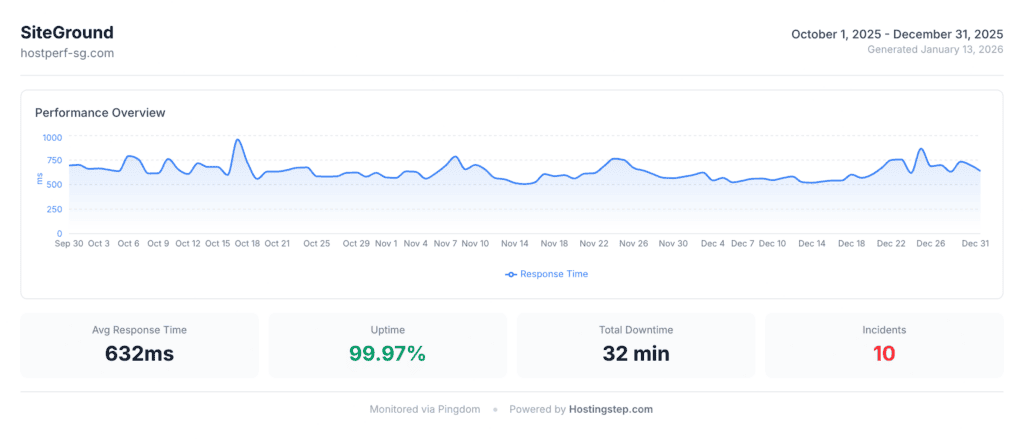
SiteGround showed genuine improvement from 2020 to 2022 since the host moved to Google Cloud Infrastructure during the period. However, the TTFB worsened every year gaining 115 ms per year on average and if this trend persists, the host would be back to 2020 level in 2026. A TTFB of 632 means the host takes over half a second just to respond before any page content loads. For a WordPress site that includes images and scripts, the total page loading time can go up to 3 to 4 seconds.
Pressable leads in this field with 341 ms, followed by WP Engine with 367 ms. Even budget hosts like Hostinger and NameCheap recorded better TTFB than SiteGround with 472 ms and 462 ms respectively. It’s worth mentioning that the max response time has gone up to 2121 ms, which is over 2 seconds in 2025, while the minimum was 502 ms. This wide variance suggests inconsistent server performance.
Uptime
SiteGround recorded an uptime of 99.97% in Q4 2025, scoring 8.5 out of 10, which is acceptable. However, as we look into the annual 2025 performance, it tells a different story with 99.96% full year uptime with 193 minutes of total downtime caused by 44 outages over 44 days. 44 outages in 2025 is a big spike compared to 18 outages in 2024 and 17 outages in 2023 and 14 in 2021.
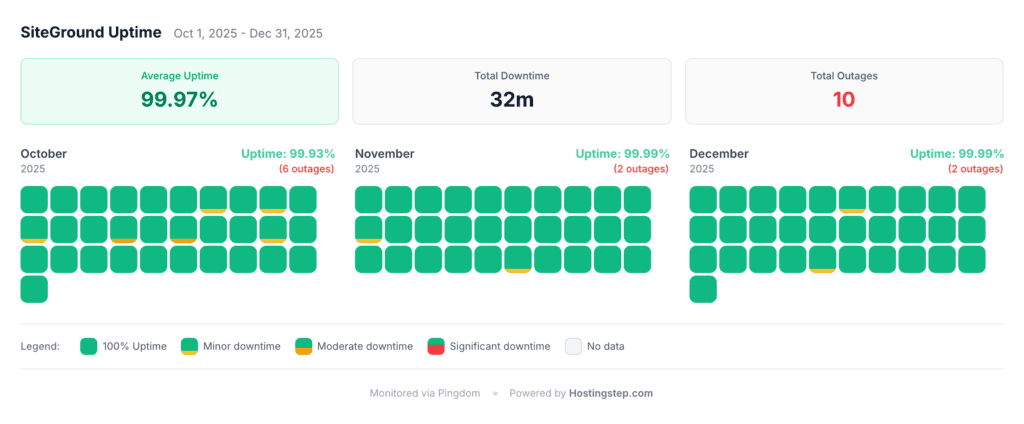
The worst single day uptime in 2025 was recorded as 95.35%, which means almost 5% of downtime with roughly 70 minutes offline in a single day. While SiteGround maintained 99.99% uptime from 2021 till 2024, the uptime dropped to 99.96% in 2025, and that was for the first time that the uptime dropped below 99.98% since the time we began monitoring.
193 minutes of uptime means 3 hours of total downtime across the year, which, for any eCommerce site doing $10k per month should cause a measurable revenue impact since every hour counts. 5 hosts that achieved 100% uptime in 2025 are WordPress.com, Pressable, and WP Engine. While SiteGround’s 99.97% in Q4 2025 is adequate, the full year’s uptime performance is a little concerning with the uptime dropping to 99.96% and 44 outages.
Load Handling
SiteGround passes the load test with an average response of 170 ms with 0% errors under a concurrent traffic of 100 users. We tested the host’s load handling by using Loader.io to send 100 concurrent users in 60 seconds. Even though the host passed the load test, and no visitor will receive any error, the average response time was not that impressive since it falls in the bracket of 150 ms to 250 ms, indicating slow page loading.
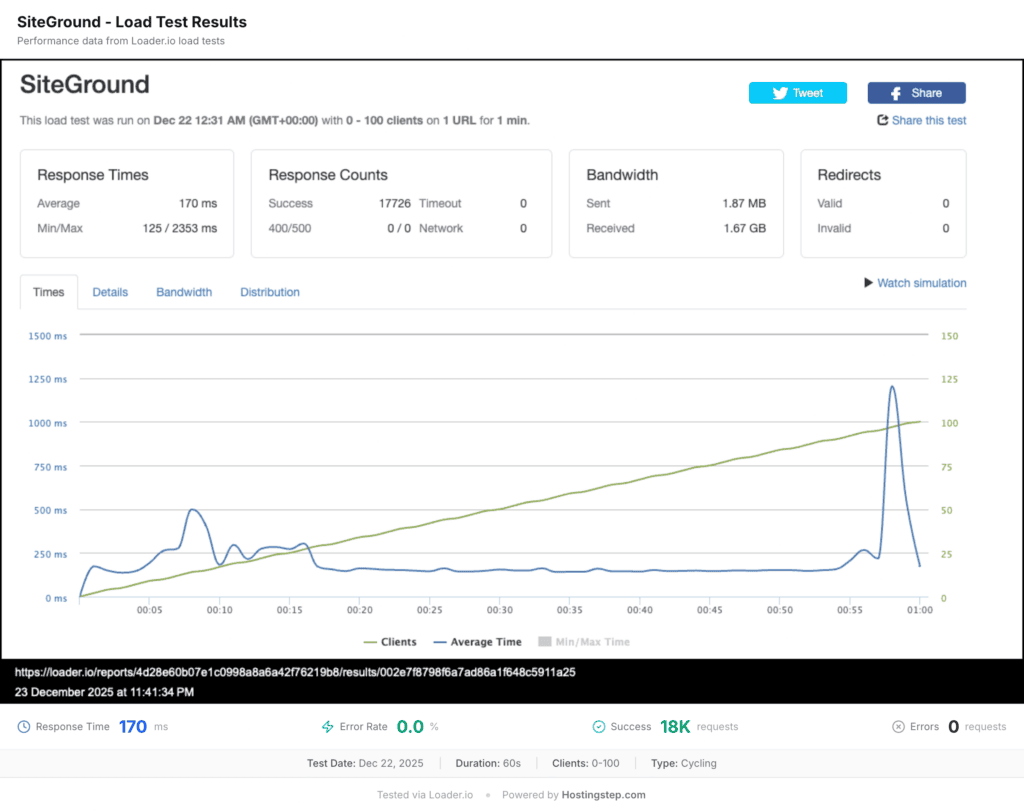
Hosts that did exceptionally well in this field include WP Engine with 27 ms, Hostinger Business with 31 ms, and GreenGeeks with 26 ms, and these hosts are 5x to 7x faster under load. SiteGround matches Bluehost’s load handling yet slightly better than the later since Bluehost had an error rate of 9% while SiteGround had none. It’s also worth mentioning that 6 out of 34 hosts we tested failed the load test entirely as they exceeded the error rate 50% and SiteGround is not in that group.
SiteGround’s 170 ms average response time with 0% error rate means your site visitors will experience slow page loading during traffic spikes but the site will stay up and running. At times like these, your site pages that usually take 2 seconds to load may take up to 3 seconds.
Server Hardware (WPBench)
SiteGround scored a WPBench score of 8.4 out of 10 and is one of the top performers in this field. Only three hosts scored higher than SiteGround which includes Bluehost with 9.6, ScalaHosting with 8.8, and Kinsta with 8.8. SiteGround’s WPBench score of 8.4 means the host allocates strong CPU, RAM, and disk I/O resources on its StartUp plan. However, SiteGround with a WPBench score of 8.4 should produce sub 500 ms TTFB but the host delivers 632.
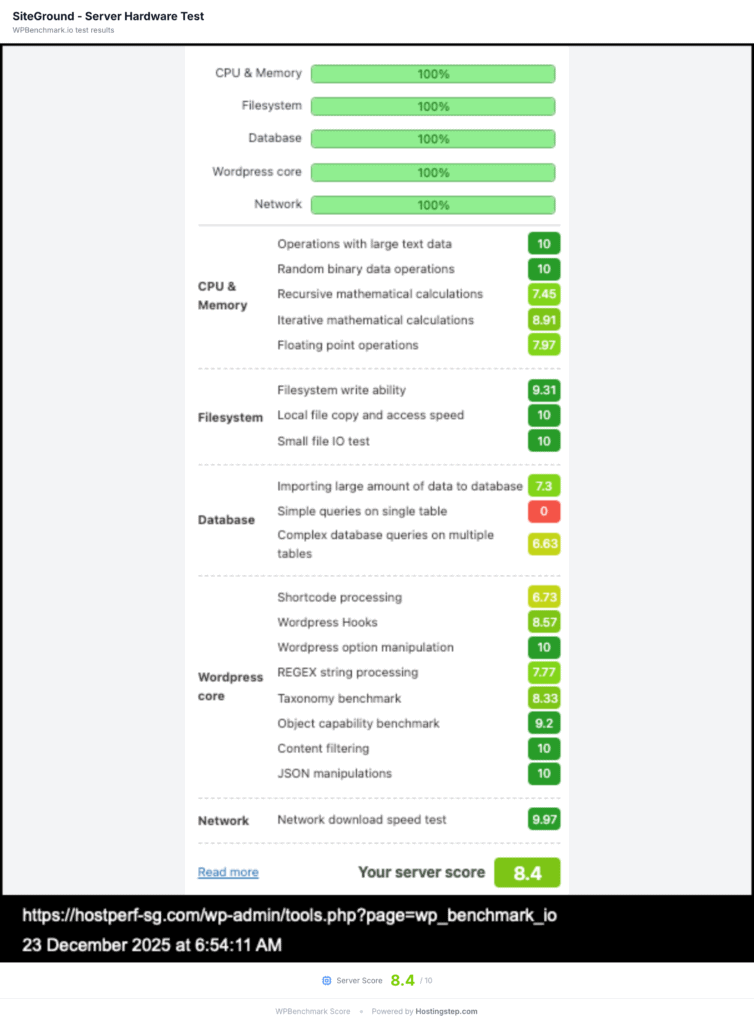
The gap suggests the bottleneck has nothing to do with hardware and is caused due to software configuration, or CDN implementation or server side caching effectiveness. For users, it means plugin heavy WordPress sites and WooCommerce stores with complex database queries will be smooth because of the strong underlying compute but the delivery speed still will remain slow. SiteGround offers more raw power than Hostinger Business with a WPBench score of 7.4 and Cloudways Vultr HF with 7 in spite of having cheaper intro price.
Global TTFB
| Region | Avg | Best City | Worst City |
| Americas | 433ms | N. Virginia 73ms | Santiago 997ms |
| Europe | 800ms | Paris 77ms | London 1.7s |
| Asia-Pacific | 1.2s | Jakarta 384ms | Delhi 1.2s |
SiteGround recorded an average global TTFB of 833 ms, scoring 4 out of 10, which places the host in the bottom quartile globally. Even though SiteGround offers a CDN Addon, it’s not edge and doesn’t offer aggressive edge caching as used by WP Engine with an average global TTFB of 169 ms or Hostinger Business with 223 ms. The global TTFB average for America is 433 ms, with N. Virginia recorded the best TTFB with 73 ms, while South Carolina’s is also good with 103 ms due to its close proximity to the origin server. However, the TTFB across the West Coast is average with 437 ms in LA and 445 ms in Las Vegas. The host recorded high TTFB in Latin America with 997 ms in Santiago and 869 ms in Sao Paulo.
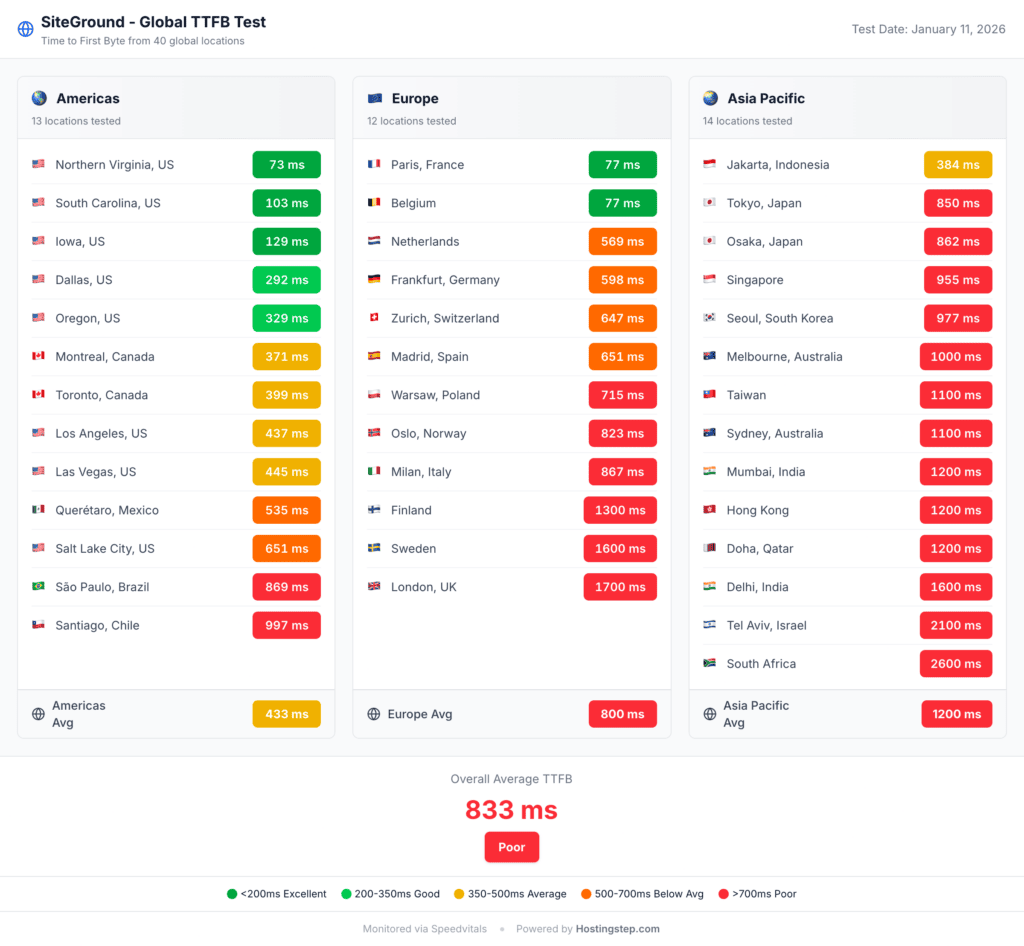
The global TTFB average in Europe is 800 ms. The TTFB was excellent in Paris and Belgium with 77 ms out of their proximity with the origin server but the TTFB in London is 1.7 seconds, Sweden is 1.6 seconds and that in Finland is 1.3 seconds, which is unacceptable. Even in Frankfurt the content delivery is slow with a TTFB of 598 ms. The global TTFB data of Europe indicates that SiteGround’s CDN is not caching effectively beyond the origin region and the page loading in London is 22x slower than in Paris.
The global TTFB is at its worst in Asia pacific with an average of 1.2 seconds. None of the Asia Pacific cities is below 384 ms with 850 ms in Tokyo, 955 ms in Singapore, and 977 ms in Seoul. For any site targeting Asian audiences, this is a dealbreaker. The best hosts in this field are WP Engine with 169 ms, Hostinger business with 223 ms, Bluehost with 345 ms, and Cloudways Vultr HF with 444 ms. SiteGround is 2x to 5x slower than these hosts in terms of global delivery speed. Choosing SiteGround can be a major disadvantage for any site that drives more than 30% of its traffic from outside the US East Coast.
SiteGround vs Competitors
| Metric | SiteGround | Hostinger Business | Bluehost | Cloudways Vultr HF | WP Engine |
| Rank | #22 | #5 | #14 | #17 | #6 |
| Score | 6.50 | 8.02 | 6.90 | 6.70 | 7.98 |
| Tier | Below Avg | Strong | Average | Strong | Elite |
| TTFB | 632ms | 478ms | 520ms | 424ms | 367ms |
| TTFB Score | 4/10 | 7/10 | 6/10 | 8/10 | 9/10 |
| Uptime | 99.97% | 99.98% | 99.95% | 99.99% | 100% |
| Load Test | 170ms/0% | 31ms/0% | 170ms/9% | 96ms/0% | 27ms/0% |
| Load Score | 6/10 | 9/10 | 6/10 | 7/10 | 10/10 |
| Global TTFB | 833ms | 223ms | 345ms | 444ms | 169ms |
| Global Score | 4/10 | 10/10 | 9/10 | 8/10 | 10/10 |
| WPBench | 8.4 | 7.4 | 9.6 | 7.6 | 6.5 |
| CDN | Addon | Static | Static | Addon | Edge |
| Included | Addon | Addon | Addon | None | |
| Backups | Daily | Daily | Weekly | Daily | Daily |
| Intro Price | $2.99/mo | $3.69/mo | $3.99/mo | $16.00/mo | $23.00/mo |
| Renewal | $17.99/mo | $7.99/mo | $12.49/mo | $16.00/mo | $30.00/mo |
SiteGround vs Hostinger Business
Hostinger wins on delivery speed across every metric including TTFB with 478 ms vs 632 ms, global TTFB with 223 ms vs 833 ms, and Load test with 31 ms vs 170 ms. SiteGround wins on hardware with 8.4 vs 7.4 and also includes email hosting for no extra charges while Hostinger charges additionally for it.
Hence, you can choose SiteGround if you need email included and strong server hardware for plugin heavy sites with target audiences based in the US East Coast alone. You must choose Hosinger Business if you want a faster page load, better global reach and a highly ranked host at a similar price point. For 1/3rd of the cost, Hostinger delivers better performance. See our Hostinger coupon page for the latest pricing.(Check Hostinger Review)
SiteGround vs Bluehost
Bluehost beats SiteGround on global reach with 345 ms vs 833 ms and WPBench score with 9.6 vs 8.4. SiteGround, on the other hand, wins on Uptime with 99.97% vs 99.95% and the host also offers daily backup while Bluehost offers only weekly backups.
You can choose SiteGround if you need daily backups and email included more than faster global delivery speed. However, if you need better global performance and raw server power, you must choose Bluehost over SiteGround. (Check Bluehost Review)
SiteGround vs Cloudways Vultr HF:
Cloudways has a leading edge over SiteGround in terms of speed with a TTFB of 424 ms, global TTFB of 444 ms, a load handling capacity of 96 ms and an uptime of 99.99%. SiteGround wins on price with $2.99 vs $16.00 and the host also wins on WPBench score with 8.4 vs 7.6. Besides, SiteGround includes email for no extra cost and offers cPanel while Cloudways offer none.
You can choose SiteGround if you are under a tight budget and want an affordable and easy to use host with email included for no additional cost. You can choose Cloudways if you need cloud level performance and want developer friendly features. (Check Cloudways Review)
SiteGround vs WP Engine
WP Engine wins on TTFB with 367 ms vs 632 ms, Uptime with 100% vs 99.97 ms, Load handling with 27 ms vs 170 ms and Global TTFB with 833 ms (Below Average tier) vs 169 ms (Elite tier). While WP Engine has a clear performance edge over SiteGround, SiteGround wins on price with $2.99 vs $23.00, and WP Bench with 8.4 vs 6.5. Besides, SiteGround offers email hosting for no additional cost while WP Bench doesn’t offer one. (Check WP Engine Review)
You can choose SiteGround if budget is your primary constraint and you can tolerate below average speed. You must choose WP Engine over SiteGround if performance and reliability matters more than 8x the cost.
Who Should Use SiteGround
Blogs and small sites with US East Coast based audiences with below 20k monthly visitors are good to go with SiteGround because of its excellent origin TTFB of 73 ms in Virginia and affordable intro price of $2.99 per month with included email. SiteGround offers an excellent value for low traffic sites that do not need a global reach.
Users who need email hosting included for no additional cost, SiteGround is one of best options to go with as it’s available at an affordable intro price of $2.99 per month plus included email at no extra cost. Hosts like Hostinger, Bluehost, and Cloudways charge extra price on email.
Plugin heavy WordPress sites or WooCommerce sites can benefit from SiteGround;s excellent server compute since the host secured a WPBench score of 8.4 indicating strong CPU, RAM, and I/O allocation. The strong hardware allocation can efficiently handle the complex database queries even though the front end delivery is slow.
Who Should NOT Use SiteGround
Sites that rely on international traffic should avoid SiteGround since the host has poor global TTFB with an average of 833 ms. The average is as high as 1.2 seconds in Asia Pacific. Such sites can choose Hostinger Business with 223 ms or WP Engine with 169 ms.
Ecommerce sites must avoid SiteGround since the host recorded a TTFB of 632 ms, which is slow for the product pages. Besides, studies show 1% loss in conversion every 100 ms latency. SiteGround’s TTFB alone adds 270 ms vs the field median of 460 ms.
Sites expecting an increase in traffic should not choose SiteGround since our data reveals a TTFB performance regression from 403 ms in 2022 to 632 ms in 2025, which raises concerns about future performance trajectory. If the same trend continues, sites growing with SiteGround may need to migrate later.
Sites with UK or EU audiences should avoid SiteGround since the host has worse TTFB in London with 1.7 seconds and Sweden with 1.6 seconds. European visitors outside France or Belgium will experience poor page loading.
Our Verdict
SiteGround scored 6.5 out of 10, ranking 22 out of 34 hosts we tested in our 2026 rankings. We recommend SiteGround for users who need an affordable shared host with email included, daily backups and strong hardware for US East Coast audiences with low traffic.
We do not recommend SiteGround for sites that need fast global page loads,and serve international traffic. We also do not recommend SiteGround for eCommerce sites where speed impacts revenue as SiteGround’s TTFB has worsened 57% over 3 years from 403ms to 632ms.
Such sites can choose better alternatives like Hostinger Business at $3.69 per month as it ranks 5 out of 34 and offers 223 ms global TTFB. While Hostinger’s intro price is slightly higher than that of SiteGround with $3.69 vs $2.99, the renewal price is much more than SiteGround with $7.99 vs $17.99.
Methodology
We monitor a total of 34 providers and the hosting accounts we use for testing were purchased with our own funds. They are not promotional or press accounts. We use Pingdom for measuring TTFB and uptime, every 60 seconds, across 22 US locations, Loader.io for load testing, SpeedVitals for global TTFB, in over 40+ cities, WPBenchmark to measure server hardware, conducting 21 tests across 5 categories.
Our methodology based testing frequency consists of over 525,600 tests per provider per year every minute, 24/7/365. Our scoring system comprises 60% on Performance (TTFB 15%, Uptime 15%, Load 15%, Global 10%, Hardware 5%) / 30% on Features (CDN, Email, Backups) and 10% on Value (intro price tier). Our Data period is Q4 2025 (October 1 – December 31, 2025) for current rankings. For writing this review, we used the SiteGround historical data from 2020, which amounts to over 1950 days of data.

Mohan Raj is the founder of Hostingstep.com, where he oversees the independent testing of 25+ web hosting providers. He conducts 525,600+ performance tests per year across 60+ global locations to measure TTFB speed, uptime, load test, core web vitals, and hardware benchmarks. Each provider is tested using independently purchased hosting accounts, backed by verifiable data.